
Mythical Tibesti

September to May

View Price

Location

Chad, Central Africa

Group Size

1 to 10 participants 

Mythical Tibesti- Overview

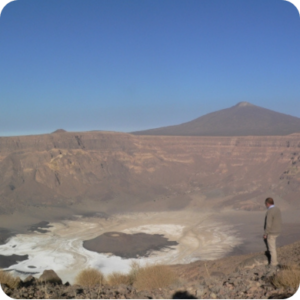
Nestled in the heart of the Sahara, the Tibesti massif is a mythical and fascinating place. This remote region of Chad houses a breathtaking volcanic landscape, a true natural treasure still largely unknown to the general public.

The majestic peaks of the Tibesti, with the highest point reaching nearly 3,500 meters in altitude, offer a stunning panorama. Gaping craters stand alongside deep canyons, witnesses to an intense past volcanic activity. The sunlight reflects on the multicolored rocks, creating breathtaking plays of shadow and light.

But the Tibesti is not just a striking mineral backdrop. This region was once home to nomadic populations who left fascinating traces of their passage, as evidenced by the numerous rock carvings scattered throughout the massif. Discovering these vestiges of a distant past is an extraordinary experience, plunging the visitor into the mystique of this mythical place.

Beyond the breathtaking landscapes and archaeological remains, the Tibesti harbors a unique flora and fauna, adapted to this extreme environment. Gazelles, mountain goats and majestic birds of prey coexist in these wild spaces, offering a captivating natural spectacle.

Exploring the Tibesti is to venture into a world apart, at the confines of the Sahara, and to live an extraordinary travel experience. A true journey to the heart of myth.

Ready to live an extraordinary expedition in one of the mythical part of the Sahara ?

Must-See

  • Crossing the Sahel
  • The Mao market
  • Zouarke
  • Trou-Du-Natron
  • Man Of Gonoa
  • The Rocks Peint of Bardai
  • Ain Galaka, Boudo, Tigui
  • The town of Faya

Itinerary

We leave the city behind, heading eastwards through Massaguet and Massakory, where the tarmac road disappears.
The landscape starts as a mixture of savannah and sahel, becoming more arid as we progress,vegetation becomes scarce and we traverse vast plains often covered in yellow grass, a remnant from the rainy season. Wildlife around
this region is good, and you can expect to see dorcas gazelles as well as jackals. For much of the route we follow the dried up riverbed of the Bah el Ghazal where remains of the oldest known hominid have been found. We set up camp each night in the middle of the wilderness, with noone else for miles

We stop first in the village of Kalait to shop in its busy market, then drive into the majestic Ennedi Mountains. We spend our time exploring their numerous rock formations – made of sandstone, the wind and sand have eroded them into weird and wonderful shapes. We also visit a number of rock art sites, hidden over overhanging rocks and depicting cows, camels and warriors, and may see ancient burial sites about which almost nothing is known. This is the domain of the Tubu, and we expect to meet nomads on their way to pasture with the camels or drawing water at wells, and pass their small groups of tents. The highlight of these few days in undoubtedly the Guelta d’Archei, the only permanent waterhole in the region situated amidst a dramatic and towering gorge, where one can often see
hundreds of camels drinking, their bellowing echoing around the rock walls. The guelta is also home to one of the last populations of Saharan crocodiles, and with a bit of luck we should be able to see them. The landscape in this region is truly spectacular and we pick our campsites in the prettiest areas. The Ennedi Mountains In the north east of Chad lie the stunning Ennedi Mountains, a red sandstone massif that has been sculpted into a mutlitude of fascinating rock formations by the wind and sand over the millennia. This is one of Chad’s most beautiful areas, with natural arches, deep gorges and isolated waterholes which makes it a real joy to explore. The Ennedi is also rich in rock art with numerous examples being found in caves and under overhanging rocks. The Guelta d’Archei is home to one of the last surviving populations of Saharan crocodiles, which live in a small waterhole – the only permanent source of water in the massif. Reduced to around 8 or 10 now no young crocodiles have been seen for many years, leading to speculation that the population is entirely male or female and thus doomed to extinction in the near future. This is a truly stunning part of the Ennedi and used by the Tubu nomads to water their camels – the sight of five or six hundred camels drinking and bellowing at this isolated patch of water is one you are unlikely to forget.

We drive down from the plateau to Fada, the only real town in the Ennedi, where we need to complete formalities and stock up on supplies before heading northwards. From here we head back into the wilderness, climbing onto a plateau of red rocks before descending to the last rocks of the Ennedi. Rom here we enter the Mourdi Depression, an area of vast sand dunes that can be difficult to traverse but are incredibly beautiful. We follow the ancient caravan route that is still used by camel caravans taking salt from Demi and Teguedei to the Fada and beyond.
We visit the small village of Demi, located at the foot of a mountain and on the edge of a salt pan, where men and women dig the red earth for salt to be transported across the desert to market, exchanged for goods like millet, sorghum and other foods – this is an incredibly isolated settlement and completely reliant on the trade. Nearby is the salt lake of Teguedei, situated amidst lush palm groves and seasonally inhabited for the date harvest – one can also see piles of salt drying on the shores of the lake. From here we head to the lakes of the Ounianga oasis. Emerging
from the desert this is spectacular site – lakes surrounded by dunes and palms with multihued mountains behind them. The lakes themselves are different colours, a result of the minerals in the ground as well as algae. We explore the lakes, visit the village of Ounianga Serir

We also stop in the town of Ounianga Kebir for supplies and formalities. Until recently this was a critical hub on the trade route with Libya, but that country’s troubles have reduced traffic to a trickle. The Ounianga Lakes Recently declared a UNESCO World Heritage Site, the Ounianga Lakes have to rank amongst some of the Sahara’s finest scenery. All are fed by freshwater springs, but in all but one the salty soil that the water filters through means that they are saline. There are a number of lakes spread between the small settlement of Ounianga Serir and the larger ‘town’ of Ounianga Kebir, including twin lakes adjacent to each other with different colours.
We leave the Lake Ounianga then head south, crossing dunes and entering an area that saw fighting during the war with Libya – in some places the remnants of tanks and other military hardware can be found, slowly being reclaimed by the desert. The dune crossing can be tough in parts and we can expect to get out and push. Time permitting we may be able to stop at small oases en route, and we camp tonight on the outskirts of the Ennedi.

Reluctantly we leave the Ennedi, stopping first at Kalait to again pick up supplies. We then head south on a different route, travelling through a more ‘African’ landscape, with settled villages and mud huts replacing the camel hair tents of the Tubu. We pass through the towns of Arada and Biltine before reaching Abeche, the largest town we have seen since N’Djamena. From here we head west – the lands here are more populated and we expect to see more people, and traffic, on our journey back. Abeche is the capital of Ouaddai province, the seat of an ancient sultanate that once played an important part in Saharan trade, linking tropical Africa to the slave markets of Tripoli. 

through the beautiful and lively region of Guera, punctuated by his granite peaks and home to some of the richest markets in Chad will be a stop at the village of Ab Toyour, dominated homonymous granite peak also known as « vultures Mountain ». We arrive N’Djamena! transfer to the hotel ,room daily use opportunity for a shower and cold drink since leaving the city Transfer to airport.

NOTE: in the program is not included first day with fly to N’djamena

Gallery

Date

Date: always available for this tour.

PRICE

Price: 260

FAQs

TERMS

TESTIMONIALS

About Us

Our Story

Team

Clients

Testimonials

Social Media

Tours

Day Tour

Cultural

Desert

Safari

Phototour

Blog

Gerewol

Ennedi

Leurs temoignages

Dernier Voyage

EYTE SARL © 2013-2025 All Rights Reserved.